


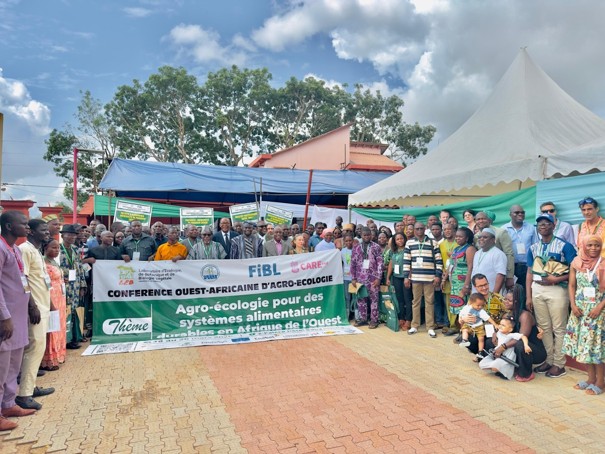
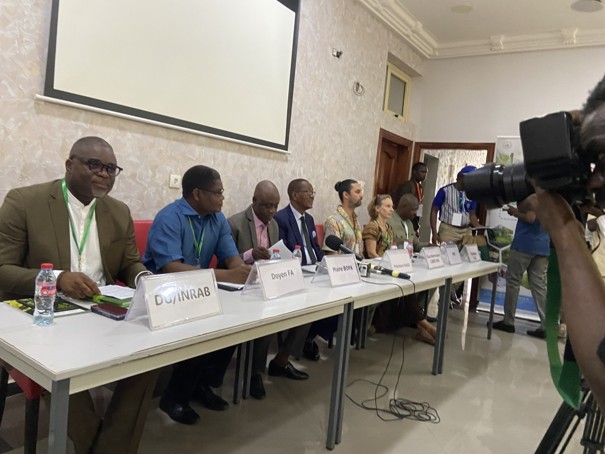
Idyllically situated on Lake Ahémé, the small town of Bopa provided the ideal setting for the conference, which was attended by around 160 people, mainly researchers, but also representatives from government bodies, NGOs and other institutions, such as the co-funding SDC, the Swiss Agency for Development and Cooperation.
Pave the way for the improved adoption of agroecology
Originally intended as a closing event for the three-year project CARE r4d (Capitalisation of agroecological research evidence from the r4d programme in West Africa), the project partners decided to turn it into a full-scale three-day conference during the course of the preparations. The project aimed not only to disseminate research findings from the large-scale programme r4d (Research for Development), which concluded in 2024, but also to pave the way for the improved adoption of the agroecological practices tested and promoted under the programme's framework.
The r4d programme was a joint effort of the Swiss Agency for Development and Cooperation and the Swiss National Science Foundation that financed research partnerships between Switzerland and African, Asian and Latin American countries to provide policymakers with scientific and development-relevant knowledge.
A wide range of topics on the conference programme
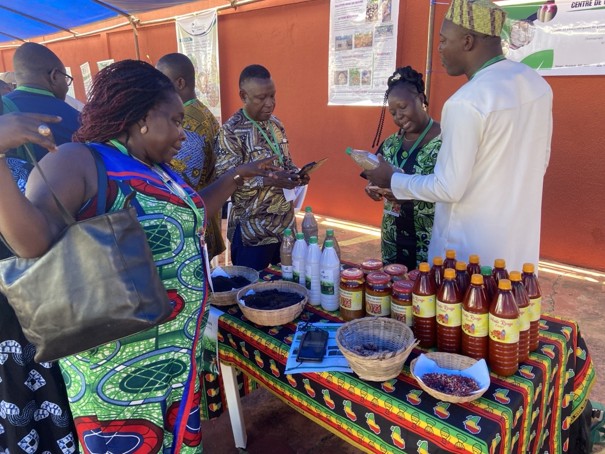
The focus was on in-depth technical discussions on the conference theme, whether in the conference hall, at the project partners' stands or during their poster presentations. It was striking that the issues of concern in West Africa are very similar to those here, albeit often with greater urgency, such as water scarcity or the lack of profitability in agriculture.
Here is a selection of agronomic topics that were addressed in the presentations and posters on the projects:
- Agroforestry
- Organic plant protection
- Food security
- Mixed cropping
- Involvement of the entire value chain
- Reduced tillage
- Water conservation
- Breeding of resistant varieties
Various socio-economic factors were also addressed and, in some cases, examined in greater depth:
- Lack of profitability in agriculture due to low producer prices
- The role of women in agriculture and the promotion of their empowerment
- Population growth, rural-urban migration
- Access to markets
From research to practice
Continuing education plays a central role in improving the situation in all four countries, on the one hand, to improve the economic and social situation of farmers, and at the same time, to embed environmental considerations more firmly. CARE r4d had therefore set itself the goal of disseminating agroecological research findings from the r4d programme in West Africa into practice.
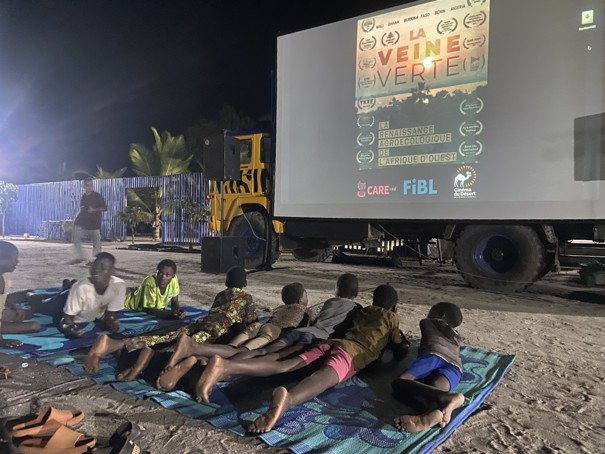
The FiBL project team, led by Fernando Sousa and Andreas Fliessbach, relied on transdisciplinary networks in Mali, Burkina Faso, Ghana and Benin. A list of project partners can be found on the FiBL project database. Using a participatory approach, they succeeded in reaching over 8700 people directly over the three-year project period. The network organised over 100 events at 53 locations. Activities included video screenings, training sessions for farmers, demonstration plots, radio programmes, theatre performances and a collaboration with the solar-powered, mobile cinema 'Cinéma du Désert'.
From the wide range of agroecological research topics, those in charge selected three for dissemination:
- Agroforestry with trees from the legume family
- Soil improvement using organic material
- The production of insects for animal feed
Progress, obstacles and the establishment of a network
The conference highlighted that, whilst a major agroecological breakthrough has not yet been achieved, progress is certainly being made. According to estimates by Charles Bertrand Pomalegni from the INRAB research institute in Benin, around 10 per cent of farmers in Benin are already using agroecological methods, and similar figures are likely to apply to the other three countries.
However, there are still significant obstacles to the wider adoption of these methods. Because production is often more labour-intensive, the products are more expensive, which makes them harder to sell. The same applies to the often-lacking knowledge within the trade. In Burkina Faso and Mali, the precarious security situation in large parts of the countries further complicates matters.
According to the project leaders, however, the project confirmed "that diverse, context-specific dissemination methods based on research findings can effectively bridge the gap between scientific knowledge and farming practice". To continue this process, the participants – and this is arguably one of the conference's key achievements – founded the West African Agroecology Network.
The closing conference provided ample opportunity to further strengthen this network, whether during the regular meal breaks or as part of the evening programme. One of the highlights was the open-air screening of the film "La Veine Verte", which documents the progress of agroecology in West Africa (further information about the film and the mobile cinema operators from 'Cinéma du désert' can be found in the links below).
More impressions of the conference can be found in a video produced by FiBL (see link below).
Further information
Contact
Links
- 4rd.ch: R4D Project-Website
- fibl.org: CARE R4D in the FiBL project database
- youtube.com: Video about the concluding conference
- vimeo.com: Video on the experience of cinema du desert
- laveineverte.org: Documentary film "La Veine verte"