


"We are breaking new ground"
Voices on climate
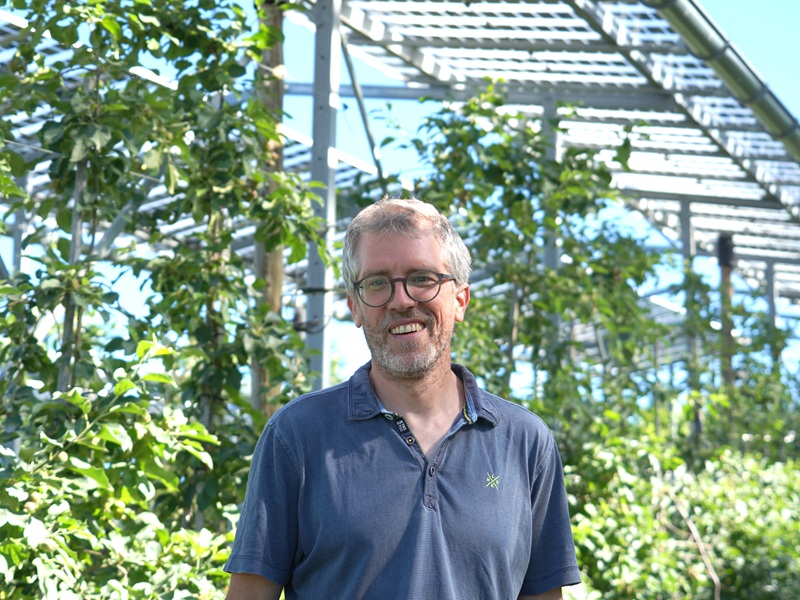
Stefan Baumann has spent more than four years at FiBL Switzerland, working in the Department of Soil Sciences on a range of climate related projects. (Photo: FiBL, Andreas Basler)
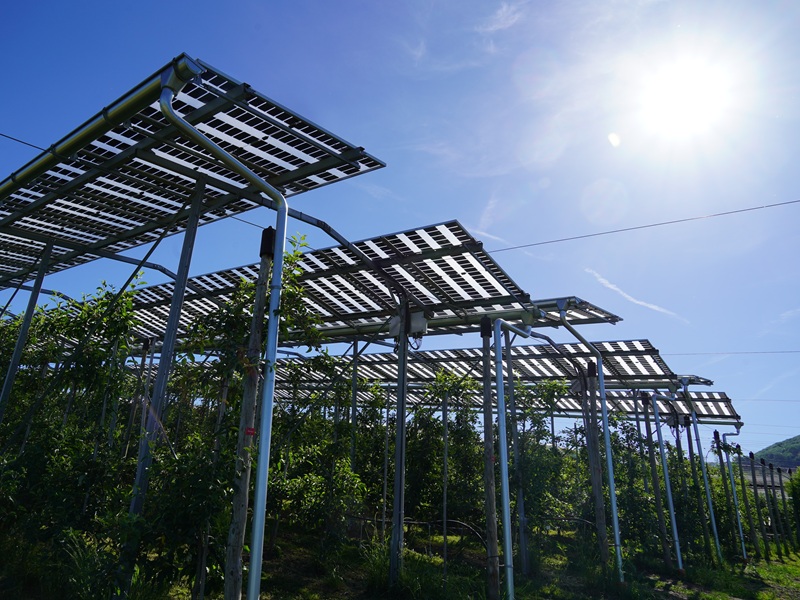
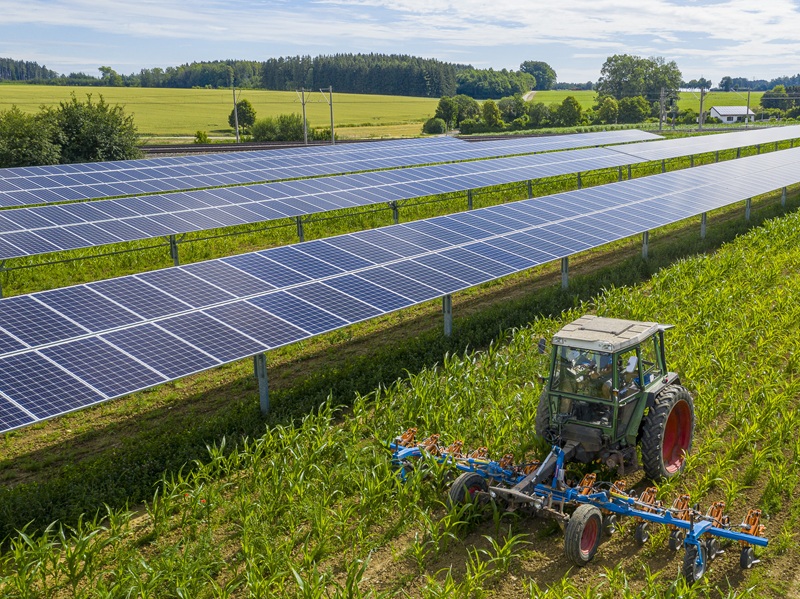
Stefan Baumann has spent more than four years at FiBL Switzerland, working in the Department of Soil Sciences on a range of climate‑related projects. He also oversees climate initiatives at Landwirtschaft Aargau, the canton's agricultural authority. Together, FiBL and the Canton of Aargau are running a research project on the use of agri‑photovoltaics (agri‑PV) in fruit production, arable farming, and pastureland — a project led by Stefan Baumann himself.
Since 2022, it has been possible to build photovoltaic systems on agricultural land in Switzerland. The prerequisite is that they not only generate electricity but also provide a demonstrable benefit for agricultural crops. What can realistically be expected here?
The requirement for dual use is indeed the key distinguishing feature compared to the situation in the EU: here in Switzerland, agricultural use must continue on land with agri-PV installations, and, furthermore, the installation must benefit production. Such benefits are best documented in berry and fruit cultivation: microclimatic effects resulting from the shading of trees and fruit during heatwaves and intense sunlight; protection against hail and late frosts; and the ability to collect rainwater in a targeted manner and use it for irrigation. Trials in the Lake Constance region also show that the need for plant protection treatments can be reduced.
In arable farming and grassland – are there comparable findings there?
Unfortunately, there is still little usable data from the EU, as the systems there are mostly geared exclusively towards energy production, without maintaining soil management. We are therefore entering truly uncharted territory here. My expectation is that the shading reduces evaporation and thus increases soil moisture – but we simply do not yet know whether this leads to higher yields or better quality. There are also open and intriguing questions regarding the benefits of combining agri-PV with permanent grassland on water balance, biodiversity or animal welfare. Does the shading help to maintain soil moisture, as suspected? How do cattle utilise these unfamiliar patches of shade?
How much interest is there from the agricultural sector?
There is a great deal of curiosity. Concrete interest exists primarily in fruit and berry cultivation. But here too, there are still unanswered questions, such as which species and varieties are suitable for combination with agri-PV systems, as well as questions regarding economic viability.
In other sectors, uncertainty prevails: economic risks, as well as the question of whether the agri-PV system brings any benefit to agriculture.
For many, the construction work is also a deterrent. Agri-PV systems are often perceived as material-intensive – cables are needed to carry the electricity away, whilst the system must withstand wind and snow. This is also the case in fruit growing, although it is precisely here that existing support and protective structures could be replaced. As for the public: there has been no negative feedback so far regarding planning applications. But much of it is still hard to imagine – perhaps things will look different once more systems are in place across the landscape.
When it comes to climate change, agri-PV is often discussed in the context of reducing greenhouse gases. Is that the whole story?
No, and that's important. Agri-PV is both: adaptation and mitigation. On the one hand, it helps us cope with heat, drought and extreme weather events – that is climate adaptation. On the other hand, we use it to generate renewable electricity – that is climate protection. Agri-PV can make a significant contribution to electricity generation, but further developments are still needed.
Under what conditions is agri-PV currently viable for a farm?
Part of our research is dedicated precisely to these questions: Which marketing models work – and under what conditions?
That depends heavily on the business model. The days of cost-covering feed-in tariffs are over. Anyone feeding all their electricity into the grid is dependent on the electricity price – and that is currently not a profitable business. Agri-PV can be profitable for farms with high self-consumption: cooling, heating and electric vehicles. Collaborations with consumers are also of interest – a neighbouring industrial plant, a residential area or the local authority.
Another option is a partnership with an electricity company: the farm is compensated for providing the land and for any restrictions. In return, the farm can benefit from a protection system – which can be quite attractive, at least for berry and fruit cultivation.
What is your key message for the coming years?
We now need to find out how agri-PV performs in practice – in terms of farming, yields and the landscape. The theoretical potential is huge. But there is still a lot of work to be done between potential and practice. What we need are reference installations, long-term data and reliable economic conditions. Then farmers can make informed decisions.
Interview: Bernadette Oehen, FiBL
Further information
Contact
Link
agrisolarforschung.ch: Website on the project "AgriSolar Forschung" (in German)