


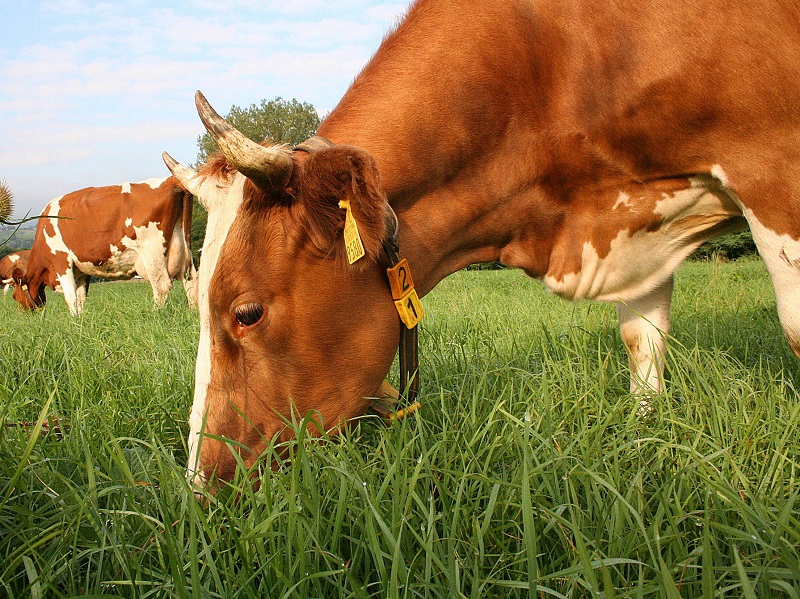
The productive lifespan of dairy cows has implications for farm profitability, resource use, the climate and animal welfare. FiBL has therefore dedicated itself to the extended productive lifespan of dairy cows as part of the five-year inter- and transdisciplinary research and dialogue project 'Extending the productive lifespan of Swiss dairy cows: influencing factors, future scenarios and strategy development', in collaboration with Agridea, HAFL, and other partners (publications containing the project's findings are linked below).
The new publication 'Extending the productive lifespan in Swiss dairy herds: impacts on greenhouse gas emissions, land use, and gross margin' uses modelling to demonstrate the conditions under which a longer productive lifespan for dairy cows has a positive ecological and economic impact.
Scenarios with varying productive lifespans
For the study, the authors developed seven model farms that are broadly representative of Swiss dairy production. These were based on Swiss-wide average data and the results of earlier studies from the project. The model farms differed accordingly in terms of breed, production zone, and production system (organic or proof of ecological performance; in Switzerland, a prerequisite for receiving state direct payments). The researchers then calculated scenarios for each model farm with short, medium, and long productive lifespans.
The results paint a consistent picture: the longer cows live, the fewer replacement animals are needed. This so-called replacement effect is the most powerful lever for reducing emissions. Greenhouse gas emissions per tonne of milk fell across all the model farms studied as the length of use increased – even where lactation performance, i.e. the volume of milk produced per cow, was slightly lower in more extensive systems. Despite the slightly lower lactation performance, extensive systems produced low emissions that were, on the whole, similar to those of more intensive systems.
Economic efficiency: productive lifespan matters most
According to the modelling, under current price conditions, scenarios with an average productive lifespan generally yield the highest contribution margins per dairy cow. However, extending the productive lifespan reduced the land required for rearing replacement animals by between 8 and 24 per cent of the farm's total area, depending on the breed and agricultural zone. The land made available could be used to keep additional productive animals or to provide ecosystem services, such as biodiversity-promoting areas or more extensively managed permanent grassland. Where these opportunities were considered, the whole-farm profitability of longer lifespan systems improved. Appropriate direct payments can make such land uses economically viable. Thus, the economic benefits of extending productive lifespan depend partly on how the land released from replacement-rearing is used.
The biggest lever: avoiding early culling
The key to extending the productive lifespan of dairy cows is not that individual cows reach a very advanced age. Rather, as many animals as possible should remain healthy in the herd beyond their second lactation. It therefore remains important to continue to focus dairy cattle breeding on long-term health and to maintain a strong focus on animal health in herd management. In particular, fertile cows with healthy udders should not be culled during their first two lactations simply because their milk yield is below average.
This finding is consistent with the views of many dairy farmers: a large proportion of farm managers surveyed through various channels cite an average productive lifespan of around six lactations as optimal. Earlier studies within the project had already shown that cows with a long productive lifespan do not start out with peak performance. Milk yield generally increases up to around the fifth lactation. A longer productive lifespan therefore makes it possible to profit from the animals' natural potential for increased performance.
Further information
Contact
Link
Publication: Pfeifer, C., Lozano-Jaramillo, M., Leiber, F. & Walkenhorst, M. (2026): Extending the productive lifespan in Swiss dairy herds: impacts on greenhouse gas emissions, land use and gross margin. Journal of Dairy Science, Vol. 109, 7186–7203. https://doi.org/10.3168/jds.2025-27896
Further publications
- Bieber, A., Hediger, F., Leiber, F., Pfeifer, C., Walkenhorst, M. (2026). Effects of productive lifespan on phenotypic lifetime daily milk yield in dairy cows: conclusions from 20-year herdbook data analysis. Animal, Vol. 20, 101842, https://doi.org/10.1016/j.animal.2026.101842
- Gazzarin C., Schmid D., Bieber A. (2025). Economic drivers of the optimal productive lifespan of dairy cows in two different Swiss milk production systems. Journal of Dairy Science Vol. 108, 12352-12372. https://doi.org/10.3168/jds.2024-26086
- Bieber, A., Lozano-Jaramillo, M., Walkenhorst, M., Eppenstein, R.C. (2024). Comparison of fertility traits, health traits and health-related management routines of Swiss dairy farms with long vs. short productive lifespan profiles. Journal of Dairy Research., Vol. 91, 403-409. https://doi.org/10.1017/S0022029925000032
- Bieber, A., Hediger, F., Pfeifer, C., Schnyder, U., Leiber, F., Walkenhorst, M. (2026). Effects of production, fertility, health, management and conformation scores on longevity in six Swiss dairy breeds. Veterinary and Animal Science, 33, 100701, doi.org/10.1016/j.vas.2026.100701
- Rödiger, M., Home, R. (2023). Systemic enablers and barriers to extending the productive life of dairy cows in Switzerland. Journal of Rural Studies 100, 103031, https://doi.org/10.1016/j.jrurstud.2023.103031