


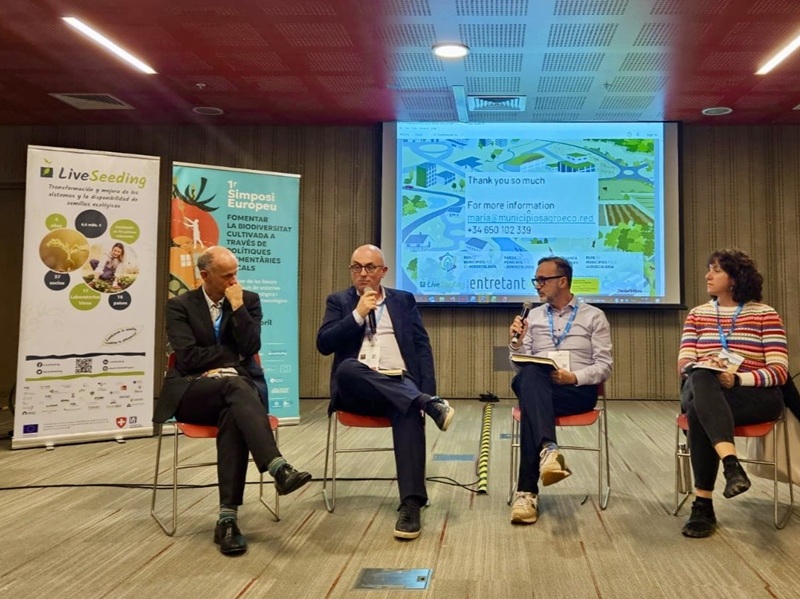
On 24 November at the Lima Convention Center, FiBL hosted the side event "Fostering Cultivated Biodiversity through Local Food Policies" together with Rete Semi Rurali (RSR), Red de Municipios por la Agroecología (RMAe) and ProSpecieRara (PSR). The workshop showcased concrete municipal actions — from community seed initiatives to public food strategies that support cultivated biodiversity — drawing on examples from Italy, Switzerland and Spain.
As Mariano Iossa (FiBL), LiveSeeding project Coordinator, highlighted in Lima, municipalities are already delivering practical solutions that strengthen cultivated biodiversity and farmers' rights, but need clearer recognition and enabling frameworks to scale. The discussion also featured contributions from María Carrascosa García (RMAe), Riccardo Bocci (RSR) and François Meienberg (PSR). María Carrascosa García highlighted the Granollers Manifesto and municipal initiatives in Spain that show how local food policies can strengthen seed diversity and support agroecological transitions, while François Meienberg shared the Geneva experience, illustrating how the right to food and public procurement for school canteens can drive food system transformation.
The workshop was very well attended and attracted a broad interest from organisations and municipalities in Europe and the Global South, highlighting the relevance of municipal action for seed and food system resilience across diverse contexts.
Takeaways from Lima for LiveSeeding and organic seed and plant breeding
The Lima Governing Body confirmed that the Plant Treaty remains at a political standstill on its core unresolved issue: how to make access to plant genetic resources compatible with fair and effective benefit-sharing. Despite years of discussion, the Multilateral System still struggles to deliver predictable contributions, and the negotiations continue to be shaped by a structural divide between countries calling for stronger sovereignty and benefit-sharing and those prioritising facilitated access.
Even if the negotiations on the Multilateral System of Access and Benefit-Sharing remained at an impasse, the idea of connecting municipal food policies and conservation and sustainable use of agrobiodiversity, presented by LiveSeeding, found its way in the official documents. In fact, in the Resolution on Conservation and Sustainable Use, the Contracting parties added a paragraph "highlighting the role that cities can play in the conservation and sustainable use of PGRFA and promoting the participation of stakeholders from these sectors in the work of the Ad Hoc Committee on Conservation and Sustainable Use (ACSU)" (Article 8, point 4).
Impact in the European Union and Switzerland
LiveSeeding partners, including FiBL Europe (Belgium), Red de Municipios por la Agroecología (Spain), Rete Semi Rurali (Italy), INRAE (France), ProSpecieRara and FiBL (Switzerland), contributed to the 'Granollers Manifesto' and encourage municipalities in the EU and Switzerland to adopt its actions. They highlight the importance of supporting regional initiatives to develop resilient varieties and produce seeds adapted to local conditions.
Further information
Contacts
- Mariano Iossa, LiveSeeding Project Coordinator
- Mariateresa Lazzaro, LiveSeeding Scientific Coordinator
Links
- openknowledge.fao.org: FAO – ITPGRFA Final Resolution 5/2025
- liveseeding.eu: LiveSeeding project
- orgprints.org: Granollers Manifesto
- zenodo.org: Manual on the Integration of Cultivated Biodiversity in Local Organic and Agroecology-oriented Food Policies
- fibl.org: FiBL Plant Breeding Group
- prospecierara.ch: Website ProSpecieRara