


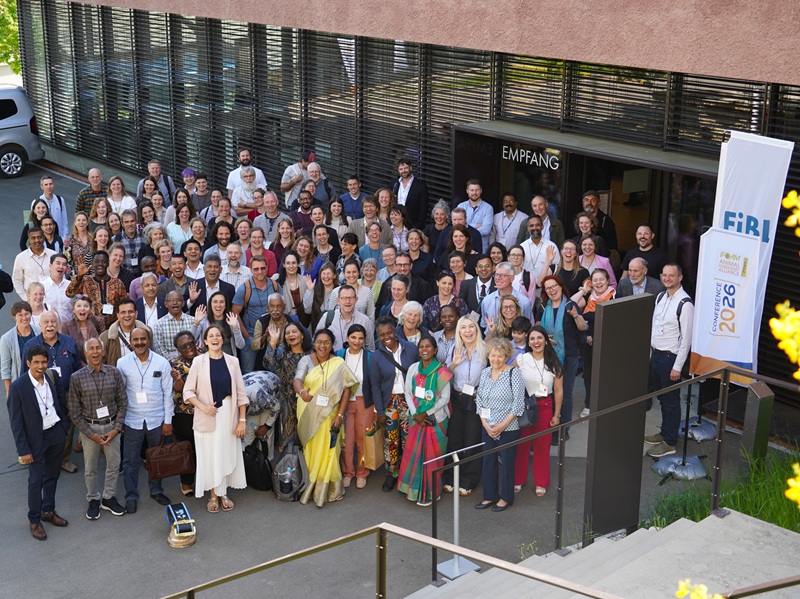
FiBL's conference building is called the Alvarium, Latin for beehive. Over the last three days, from 28 to 30 April, the Alvarium and the entire FiBL site in Frick were, fittingly, as bustling as a beehive. The reason was the IAHA Conference 2026, with around 150 participants in attendance.
The conference was organised by FiBL and IAHA. IAHA stands for "IFOAM Animal Husbandry Alliance". It is the discussion platform for livestock farming within IFOAM, the International Federation of Organic Agriculture Movements.
Three days dedicated to organic livestock farming
The participants – researchers, farmers and representatives of associations – from Africa, the Americas, Asia, Europe and Oceania spent three days debating organic livestock farming in general and, in particular, the conference theme "Organic animal husbandry: a role model for the future of livestock?".
A definitive answer to this question cannot be found within three days, even when the industry's most knowledgeable minds are gathered. The final declaration is, therefore, still being drafted and will be published here in the coming weeks.
Organic farming needs animals
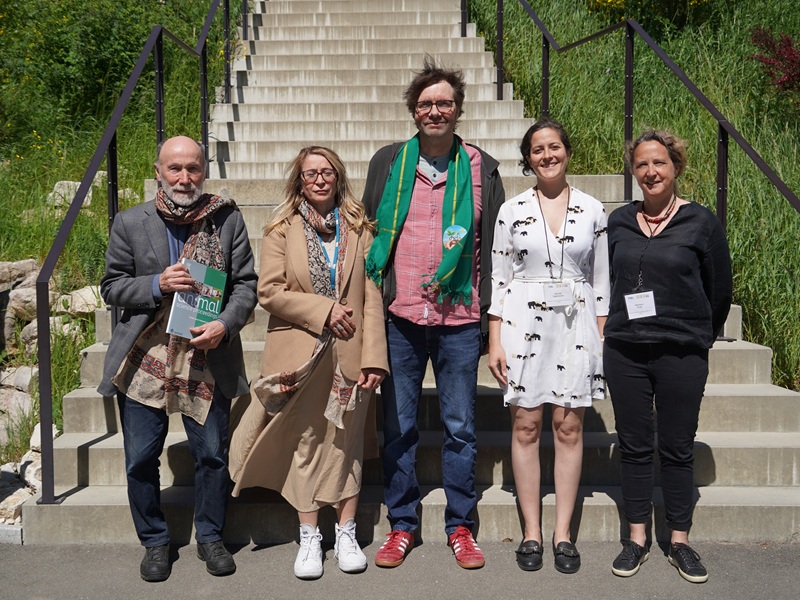
However, there was no dispute over the fact that organic farming needs animals. On the one hand, because they play an important role in closed-loop systems on organic farms. On the other hand, because consumer demand for animal-friendly and sustainably produced organic animal products is high, and consequently their economic significance is also significant. At a press conference to mark the start of the conference, both Jürn Sanders and Florian Leiber from FiBL, as well as Julia Lernoud from IFOAM, emphasised this fact.
It is equally undisputed that husbandry conditions and animal welfare in organic farming must be further improved; for this reason, conference participants discussed, among other things, ways in which this goal can be achieved for all livestock species.
Extensive programme
Alongside the extensive programme of lectures, debates and poster presentations, there was ample time at the IAHA conference for social interaction and the assessment of Swiss organic livestock farming. On the final day, several excursions were available to choose from. Thanks in part to ideal weather, the farms visited and FiBL were able to present themselves in the best possible light.
At the closing of the conference, participants bid farewell to their long-standing chair and FiBL pioneer Otto Schmid with a standing ovation. Schmid was one of the co-founders of the IAHA, which was launched in Hamburg in 2012. For the past 14 years, he has served as chair of the IFOAM platform for livestock farming. His role is now being taken over jointly by Muazzez Cömert from Turkey and Florian Leiber from FiBL.
Further information
Contacts
Links
- iaha2026.org: IAHA conference website
- sciencedirect.com: Conference proceedings
- ifoam.bio: IFOAM website