


"Ruminants contribute significantly to the resilience of food production"
Voices on climate
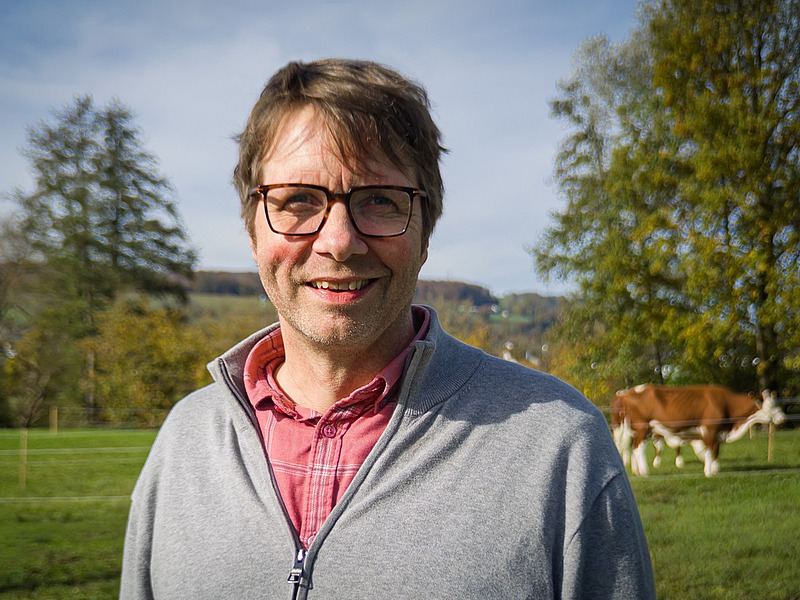

Florian Leiber is an agricultural scientist who has been researching grassland-based production systems and sustainable feed resources for 25 years. He has been working at FiBL since 2012, where he heads the Animal Nutrition Group. He is co-author of the fact sheet "Cow and Climate", which FiBL published at the end of 2025 in collaboration with Bio Suisse, the umbrella organisation of Swiss organic farmers.
Cows and other ruminants are criticised for contributing to climate change because they emit methane. Why does this happen?
Methane is always produced when plant fibres are broken down in the absence of oxygen. This also happens in the rumen of cows and is a process that follows chemical and biological laws. Cows are criticised because we all care about preserving our climate and therefore keep a close eye on everything that contributes to global warming. This supposedly includes methane from cattle stomachs.
Why supposedly?
Methane is a powerful greenhouse gas, but it only remains in the atmosphere for a very short time. This means that the methane produced in the stomachs of ruminants does not have a cumulative effect: unlike CO2 from the combustion of fossil fuels, it does not accumulate in the atmosphere. In the 30 million years of ruminant evolution, their belching has not seriously harmed the climate. It is only in the context of industrialisation that cattle methane floats like cream on the huge CO2 lake, and we are discussing whether it could be skimmed off particularly easily. However, the lake's surface is mainly fed by fossil fuel combustion and its consequences, and will continue to rise regardless of ruminant methane if we do not reduce these emissions.
Nevertheless, there are voices calling for the abolition of cattle farming for climate protection reasons. What do you say to that?
If we were to eliminate all cattle on earth, we would have an effect of three to five per cent on our emissions – that is the proportion of ruminant methane in anthropogenic greenhouse gases. And because of the short half-life of methane mentioned above, this would only last about 20 years. After that, it would have evaporated, and we would probably still have combustion engines, but no more ruminants. We could hardly provide greater proof of human short-sightedness. Of course, we currently have an extremely large number of cattle worldwide and need to reduce their numbers. But as we all know, we should be careful not to throw the baby out with the bathwater.
It is obvious that we humans benefit from milk, dairy products and meat thanks to ruminant farming. But these animals provide many other "services" – what are they? Can they even contribute to climate protection?
Ruminants enable us to use most of the world's agricultural land – grassland – for food production. In doing so, they contribute significantly to the resilience of our food production and thus make a huge contribution to the climate resilience of humanity.
From your perspective, what does sustainable, climate-friendly ruminant farming look like?
It is clearly grassland-based, which naturally limits the number of animals and implies that almost no arable land is used for concentrated feed. It also means that global grassland resources are incorporated into the world's food supply in a productive and sustainable manner. There is still a lot of room for improvement in terms of productive land use and sustainable management, especially when viewed globally. The climate-friendliness of ruminant systems lies not in methane reduction, but in the long-term preservation of grassland resources for future generations – and this can only be achieved through careful use.
Interview: Theresa Rebholz, FiBL
Further information
Contact
Links
More detailed information on this topic can be found in the fact sheet "Cow and Climate" and in the podcast "Cow and Climate: Criticism, Facts and Potential" with Florian Leiber and Catherine Pfeifer from the Department of Food System Sciences at FiBL.
- Fact sheet "Cow and Climate" (in German and French)
- Podcast with Florian and Catherine (in German)