


"The challenge is to mitigate these extremes"
Voices on climate
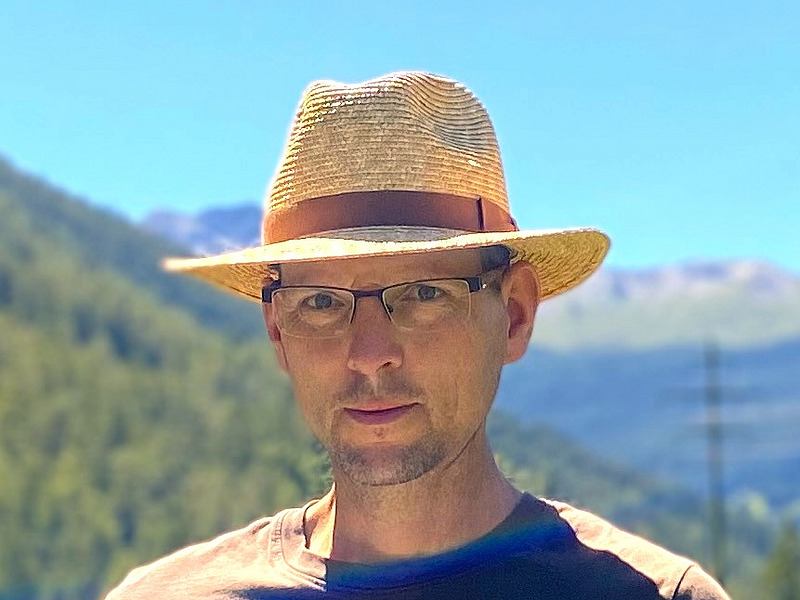
Daniel Böhler runs a biodynamic farm in Mellikon, in the Swiss canton of Aargau, and works at FiBL as a field advisor in the Arable Farming Techniques Group. (Photo: Sina Böhler)
Daniel Böhler runs a biodynamic farm in Mellikon, in the Swiss canton of Aargau. On 25 hectares, he keeps dual-purpose cattle for pasture-based fattening and rearing and cultivates arable land. Alongside his work as a farmer, Daniel Böhler works at FiBL as a field advisor in the Arable Farming Techniques Group, focusing on soil tillage, undersowing and grassland-based beef production.
How does climate change affect your work on the farm?
Basically, I always adapt to the circumstances. In that sense, climate change and the weather affect every aspect of the farm. For the pumpkins, we have been installing drip irrigation where necessary since 2023. Thanks to undersowing in our cereal crops, we can largely avoid tillage in the summer and postpone it until the autumn. Due to the heat this year, many of the undersown crops have not developed as hoped, which is why we still have to till the soil in the summer.
Climate change also plays a role in cattle farming. Some of our animals go up to the alpine pastures in summer, which takes some of the pressure off us. Apart from short periods in spring, our cattle graze exclusively at night. We always keep a feed supply for around two months so that we can draw on these reserves in the event of a drought. But this summer, that won't be enough. I hope we'll be able to harvest some supplementary fodder again in the autumn. However, in the case that the drought persists, we've ordered roughage pellets as a precaution to top up our winter supplies.
Are there many things you've started doing differently because of climate change?
Ten years ago, we decided to use edible pumpkins, amongst other things, as a substitute for silage maize, as they are a heat-loving crop. Due to this year's conditions, we are also increasing the proportion of lucerne in our feed mixes once again. However, in the current debate about heat and drought, we mustn't forget that we recently had an extremely wet year. For me, climate change doesn't just mean drought, but also periods of heavy rainfall. The challenge lies in cushioning these extremes, whichever way they go, and finding practical solutions on the farm. For me, a certain degree of diversification on the farm is part and parcel of sustainable and climate-resilient food production.
You often visit other farms. In your view, are they prepared for climate change?
That's difficult to say. When it comes to how we intend to deal with such weather extremes, everyone has a role to play. On the one hand, farmers, researchers and advisory services; and ultimately, society as a whole – not least to ensure fair prices. It's not a given that we'll be able to harvest the same amount every year – if there's no rain, it simply isn't possible. Irrigation, where it's even possible, only makes sense for crops with high added value. We need the market to understand the need to allow for greater flexibility in purchasing terms. And for crops that can be stored or processed, we need solutions to mitigate price fluctuations.
For you, livestock farming is an important element in these cycles. Could you ever imagine producing without animals?
No, for me, ruminants – especially cattle– are an integral part of food production. On arable land, we grow crops that contribute directly to human nutrition. But clover-grass mixtures should and must have space. They're important for soil fertility and can be transformed into food for humans via the animals' roughage.
Do you feel that cattle farming is already reaching its limits?
Livestock farming will continue to have a future. The grass produced by natural and sown meadows should be able to be converted into animal protein. Cattle, in particular, are and will remain integral to soil fertility. With other animal species such as pigs and poultry, which compete directly with human food supplies, we need to consider what proportion we are willing to accept. Breeding programmes need to produce hardy animals – whether for milk or meat production – that can cope with more extreme climatic conditions. Measures are also needed in terms of husbandry, for example in the design of livestock housing.
Research and advice are needed so that we can adapt to the animals and plants. That is also our role at FiBL and at all the other institutes that deal with such issues. Complaining achieves nothing. We must look ahead and develop solutions. But simply giving up livestock farming – and in particular grassland-based milk and meat production in Switzerland – is out of the question for me. Where there is potential, we must make use of it. And where livestock farming is problematic, we must scrutinise it. But in order to make sound decisions about future food production, we need a scientifically sound basis.
Interview: Ursina Wolleb, FiBL
Further information
Contact
Link
bioaktuell.ch: Article on drip irrigation (German)