


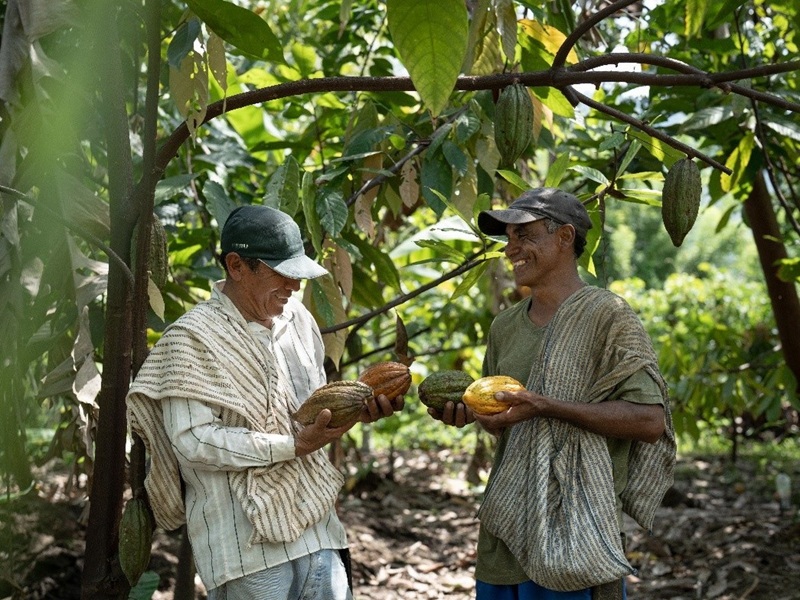
The study draws on a survey of 287 smallholder producer organisations in 34 countries, representing more than 268,000 EU-certified organic farmers – including 76 cocoa groups with around 52,500 farmers. Interviews with producers, European traders and certification bodies, as well as import data, complete the picture.
By 2024, EU organic cocoa imports had fallen by around 40 % compared with 2018–2022. In 2025 they recovered strongly but remained about 9 % below that level. Record prices and volatility, the transition to the new EU Organic Regulation, preparations for the EU Deforestation Regulation (EUDR) and climate effects all played a part.
Higher compliance costs, mainly borne by producers
Since 2025, the EU Organic Regulation (EU) 2018/848 has required organic imports from most non-EU countries to comply with the same rules as EU production, including new rules for producer groups. Around three quarters of the 76 cocoa groups surveyed made organisational changes (e.g. excluding farmers or setting up new legal entities), and the number of organic farmers certified for the European market fell by about 7 % from 2024 to 2025.
Certification fees per farmer rose by about a third for the median organisation, and about fivefold in large organisations with more than 2,000 farmers. Internal control costs, however, are at least twice as high as external certification fees. Including external and internal costs, total control costs per farmer rose by 38 % for the median cocoa organisation, and all 21 cocoa organisations with data for both years reported an increase.
More than 70 % of cocoa groups finance these higher control costs partly or primarily from the Fairtrade Premium, which is intended for social and community investment, and 29 % have reduced the organic premium paid to farmers as a result.
The additional compliance costs therefore need to be reflected in prices rather than borne by producers alone. For a typical organisation, the new Fairtrade Organic Differential of USD 450 per tonne, in force since October 2026, should cover the higher control costs and still leave enough to pay farmers at least a small organic premium.
Beyond cocoa: a steeper decline in farmer numbers
Across all crops surveyed, among the 139 organisations with data for both years, the number of EU-certified organic farmers fell by 39 %, and in coffee by 53 % (mostly in Africa). A sister study on coffee will follow.
Relief in sight for producer groups
In October 2026, the European Parliament and the Council reached an agreement (see link below) on amending the EU Organic Regulation 2018/848. Among other things, it revises the basic requirements for groups of operators.
The farm size limit for group members will double to 10 hectares or a EUR 50,000 organic turnover, and groups of operators can be part of a farmers' organisation and will no longer need their own legal personality. Once formally adopted, the amended regulation is expected to enter into force before the end of 2026.
Outlook and recommendations
No cocoa organisation surveyed plans to give up organic production, and more than half have an optimistic outlook and see the main adjustments behind them. However, 46 % expect to shrink or are still uncertain.
The study recommends that buyers and brands pay a reliable organic differential, in line with the new Fairtrade differential – also for sales outside Fairtrade – combined with multi-year commitments, risk sharing and pre-financing. Further targeted policy measures under the EU's organic road map could help reduce control costs. Donors and development programmes remain important for training and for initial certification costs during conversion, which market prices alone are unlikely to cover.
Funding
The study was conducted jointly with Fairtrade International through a grant from the SWISSCO Peer Learning and Collaboration Programme, which is supported by the Swiss State Secretariat for Economic Affairs (SECO).
Further information
Contact
Links and downloads
- orgprints.org: Study "Securing Organic Cocoa Supply Chains – How regulation and market turmoil are reshaping organic cocoa and other smallholder value chains" (incl. annexes)
- fibl.org: Project "Securing organic cocoa supply chains" in the FiBL project database
- kakaoplattform.ch: Project description on the Swiss Platform for Sustainable Cocoa
- consilium.europa.eu: Council of the EU press release "Council and Parliament strike deal on updated measures to support organic farming in the EU"
- consilium.europa.eu: Final compromise text of the amended EU Organic Regulation