


![[Translate to English:] Organic cotton-based farming systems and their role in sustainable development.](/fileadmin/_processed_/5/b/csm_1862_a7ec88b35b.png)
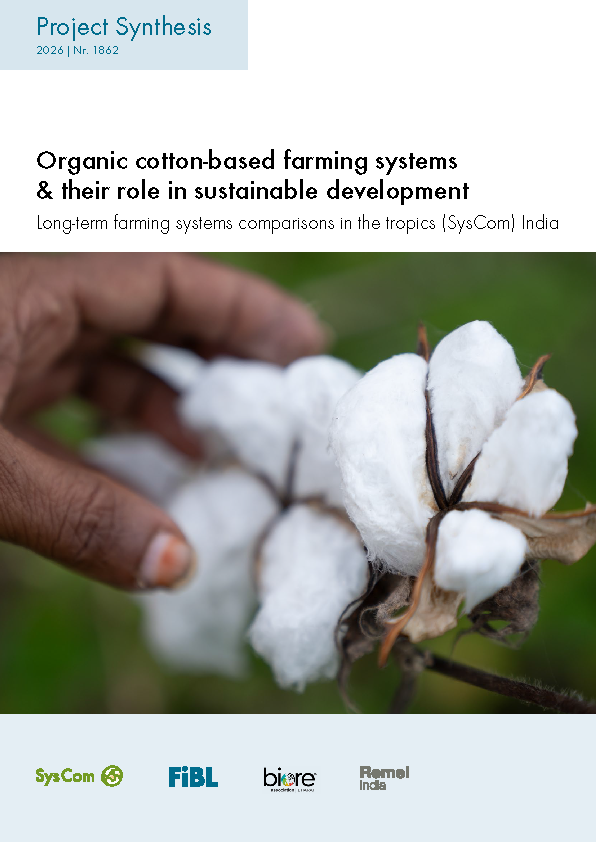
FiBL has released a new, evidence-based project synthesis that highlights 16 years of findings from the SysCom India project, comparing organic and conventional cotton systems. The findings, together with evidence from other studies, show that organic cotton offers clear social, economic, and environmental benefits.
Key messages
Organic farming improves food and nutrition security by promoting greater crop diversity and reducing workers' exposure to harmful pesticides, while empowering women and marginalised communities.
Economically, organic yields can match those of conventional agriculture when supported by good management, improved varieties, and adequate soil fertility. Although labour demands are higher, lower input costs and high-value intercrops can offset expenses.
Environmentally, organic systems show higher soil organic carbon, greater biodiversity, and stronger ecosystem health. The report concludes that true cost accounting is needed to reflect the hidden social and environmental costs of conventional farming and better support the transition to sustainable organic systems.
About SysCom India
SysCom India has generated rare long term evidence showing that organic cotton can reach 82 to 93 per cent of conventional yields while offering greater economic stability through diverse rotations and farmer centred management. Two major achievements include establishing one of the world's longest running cotton system comparison trials and fostering close collaboration with thousands of organic cotton farmers to strengthen knowledge exchange and innovation.
The findings are highly significant for Indian cotton cultivation, demonstrating that well supported organic systems can improve livelihoods, reduce environmental pressures, and enhance long term sustainability. Continued research is needed to better understand soil processes, climate resilience, region specific rotations, and scalable pathways for wider farmer adoption
Acknowledgements
This work would not have been possible without the dedication of all the team members. Special thanks to local partners bioRe Association and Remei India Limited. Thanks to the funders of the SysCom Program, including the Swiss Agency for Development and Cooperation (SDC), the Liechtenstein Development Service (LED), Biovision, and especially to the Coop Sustainability Fund.
This publication is available for free download.
Further information
Contact
Links
- fibl.org: Report "Organic cotton-based farming systems and their role in sustainable development"
- systems-comparison.fibl.org: Farming Systems Comparison in the Tropics (SysCom)
- fibl.org: Project entry SysCom "Long-term farming systems comparisons in the tropics"