


"It's a way of thinking that goes beyond my lifetime"
Voices on climate
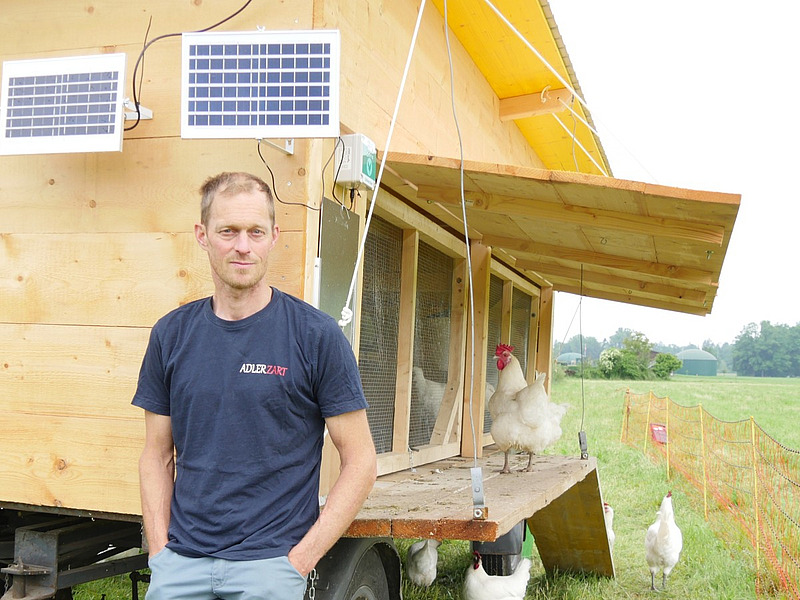
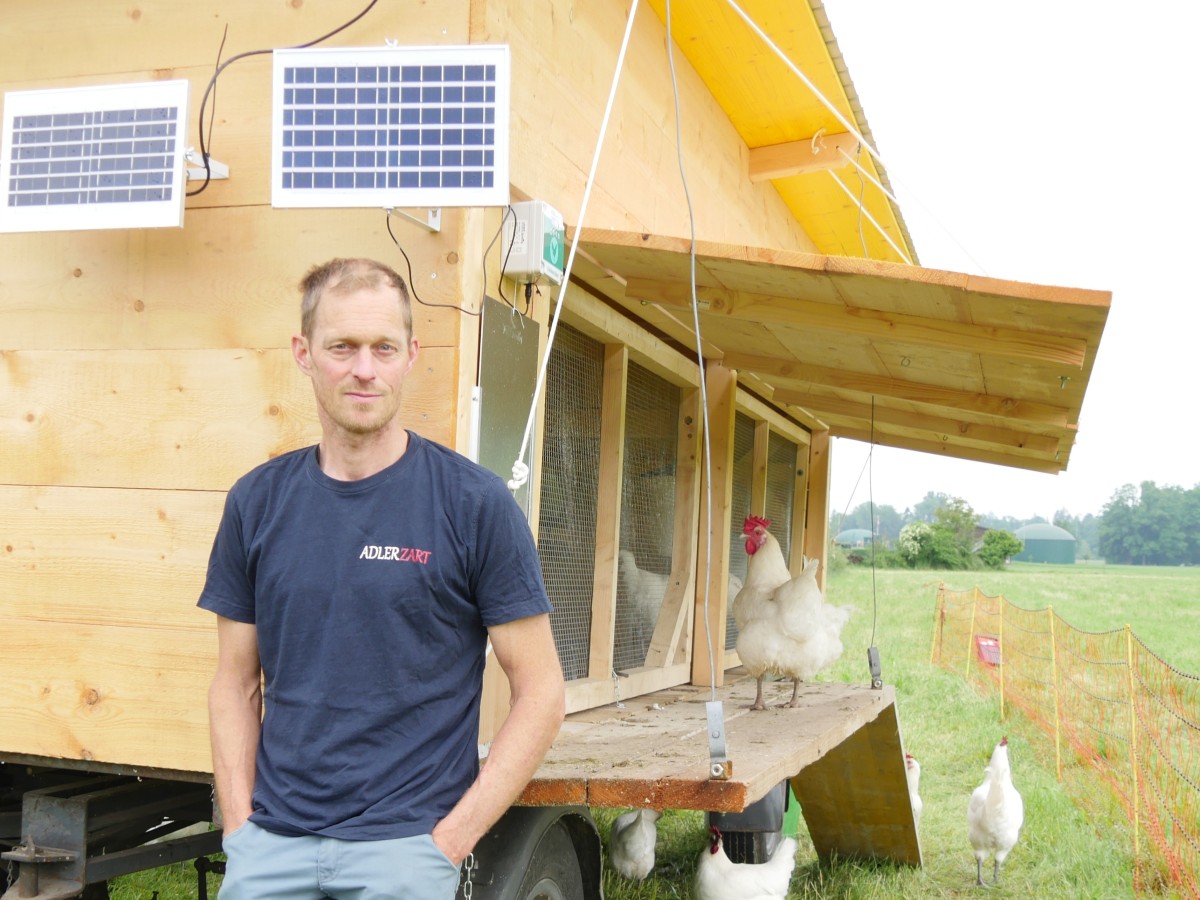
Farmer Pirmin Adler runs the Adlerzart farm in Oberrüti in the canton of Aargau, with 22 hectares of agricultural land, on which he keeps suckler cows and free-range poultry. He also practises agroforestry – where he collaborates with FiBL – and sells his produce directly. He recently won two awards at the "Prix Climat" organised by the Swiss Climate & Agriculture Network.
What is the first thing that comes to mind when you hear the term climate change?
Pirmin Adler: There is a lot of talk and little action. People like to point the finger at others instead of being a little self-critical. I notice this especially when I talk to private individuals. Very few people critically question their behaviour. It's often the little things: what do I shower with, how often do I need the car, how and where was the food on my plate produced? In the climate debate, too many people focus solely on CO2 emissions, but the climate issue is much broader than that.
You recently won the "Prix Climat" double, i.e. the audience and jury prizes. Congratulations! What activities did you receive the award for?
Thank you! It was a neck-and-neck race between all the nominees. I applied with a holistic operating concept that offers biodiversity-promoting structures and practical solutions for climate adaptation and animal welfare. It includes various effects on water balance and microclimate, carbon storage and resource conservation. We are trying to move towards self-sufficiency, for example, by reducing our purchases of minerals, electricity, and fuel, and by reducing our reliance on veterinary medicine.
Do these climate-friendly measures also pay off financially at the end of the day?
That's a good question. These are long-term investments in resilience and self-sufficiency.
Keyword: self-sufficiency. Without imported fossil fuels, Swiss agriculture would no longer be viable. What is your view on this?
I see opportunities in reduction first and foremost. In arable farming, we should work in such a way that as few passes as possible are required: one pass for tillage and sowing. I want to use mixed crops and undersowing in such a way that virtually no maintenance is required for the crops. And ideally, after the main crop has been harvested, the undersown crop is already there and does not need to be ploughed and sown again. This is also an investment in soil fertility.
What about yields?
In the short and medium term, I will certainly have lower yields because it takes an extremely long time to establish these systems. I also have to sacrifice land for soil development and self-regulation. But I have no choice but to invest more in ecosystem services. They are truly indispensable and of great value. It's a way of thinking that goes beyond my lifetime; we have to maintain the ecosystem holistically.
Where do you see further potential for making Adlerzart even more climate-friendly?
The focus is on what I have started. I want to establish agroforestry on all areas, which is definitely the top priority. In addition, I am trying to work in an even more resource-efficient manner.
Are you also a regenerative farmer?
(hesitates) Yes, I am, in a constructive, holistic way. I try to take a holistic approach.
Do current agricultural policies and the market offer you enough support for this holistic approach, or do you see yourself as a lone voice in the wilderness?
I am involved in groups that think similarly to me, and it seems to me that these are growing in size, although we are still in the minority, of course. But I believe that together we can make a difference. I try to inspire my colleagues, and I am partly successful, even though there are still many obstacles, such as legal ones. It is also important to win over private households to our ideas. Thanks in no small part to the support of various organisations, research and government agencies, we have also succeeded in putting agroforestry on the agenda of the 2030+ agricultural policy.
Speaking of research, how do you assess the work of FiBL in this context?
Very active and committed. I find it really enriching that FiBL is doing a lot in the area of leaf feeding, for example, and has even planted its own fodder hedge.
Are there any areas that research should focus on more?
I am really positively surprised by the wide range of activities. There are also projects on my farm, for example, from the ZHAW. A lot is happening internationally, too. One stumbling block is the composition of the Swiss Parliament. In my opinion, there are too many like-minded people in one boat, from agriculture to industry. It is a huge power that is primarily committed to the existing system.
Interview: Adrian Krebs, FiBL